Hyper Entrepreneur Dispatch
controversial: 2 mega prompts
May 26, 2025
There’s one skill I rarely see talked about in AI circles. It’s not in the prompt guides. Not in the YouTube breakdowns. Not in the systems being passed around by the growth-hacker crowd.
But it quietly shapes everything.
It determines whether you use AI to build real leverage, or whether you just end up automating your own confusion with better tools.
It’s not your intelligence.
It’s not your strategy.
And it’s not your experience either.
What it actually comes down to is your level of self-awareness.
This one skill has made me more money, saved me from more burnout, and unlocked more creative leverage than anything else I’ve practiced in business. And while yes—journaling, years of therapy, and reflective habits played a role—what’s surprised me recently is how effective AI can be in helping you train this same muscle.
For $20 a month.
Literally anyone can use ChatGPT to become more self-aware: faster, deeper, and in real time.
But there’s a catch:
Most people are using it the wrong way.
Here’s my mini guide, including several prompts:
Self-Awareness Is Not a Mood. It’s a System.
The kind of self-awareness I’m talking about isn’t the motivational Instagram version.
It’s not “know yourself” in some vague, spiritual way.
What I mean is functional self-awareness.
The kind that shows up in how you make decisions under pressure.
How you structure your calendar.
How you write.
How you delegate.
Even how you prompt ChatGPT.
It’s quiet. But it’s always there.
And here’s the core truth:
You won’t grow your business, or your life, beyond your current level of self-awareness.
If you want them to grow, you have to grow with them.
Which is why I’ve started thinking of self-awareness as an internal tech stack.
Something you build.
Something you update.
Something that either compounds your clarity, or quietly caps it.
The Actor vs. The Watcher
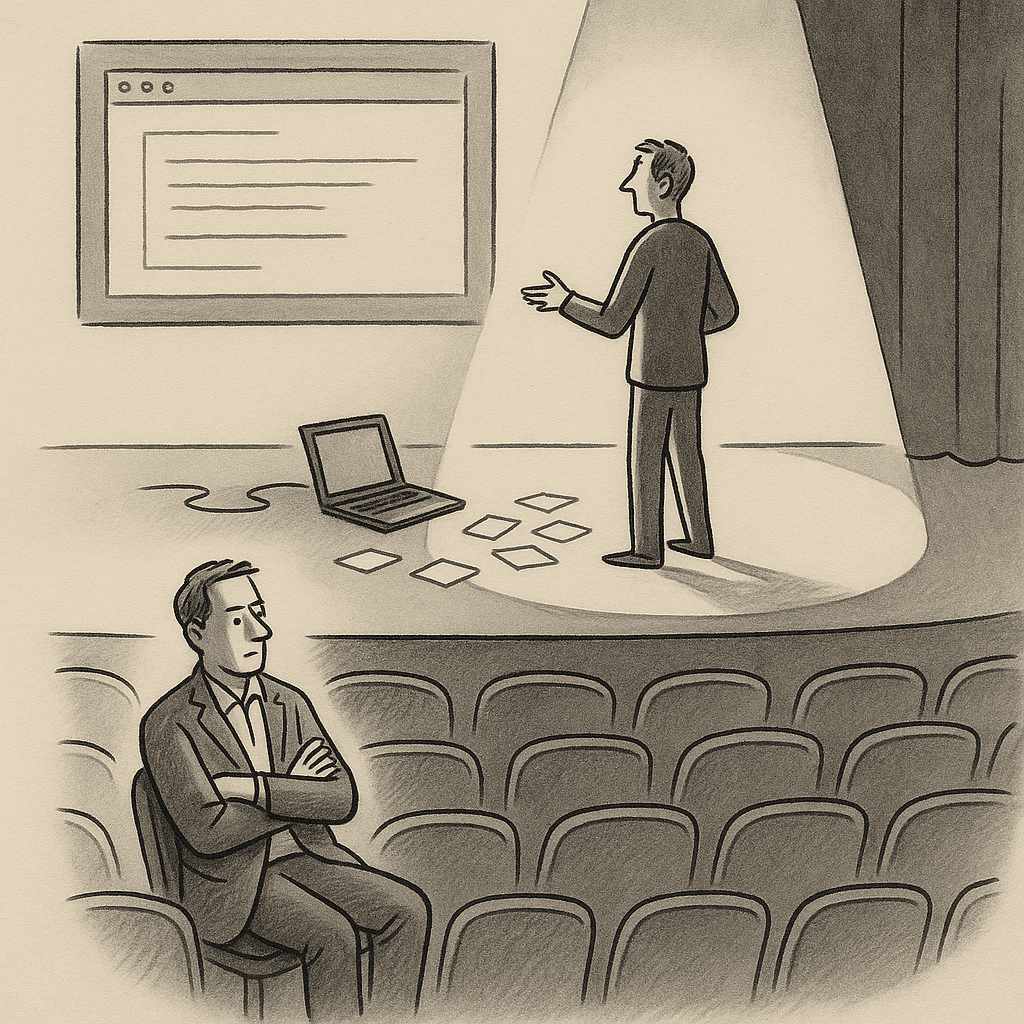
The best way I’ve found to describe this shift is simple.
Most people are actors in their own life. They’re in the scene, saying the lines, reacting in real time. And that’s fine. Until it’s not.
The moment things get chaotic (or emotionally charged, or high-stakes) being the actor becomes a liability. You can’t see clearly from inside the role.
But if you can step back, even slightly, and become the watcher—everything changes.
You’re still in the theatre. But now you’re watching yourself.
You can see your own pacing.
You can hear your tone.
You can name the energy behind your decisions.
You’re not caught inside the moment. You’re holding the moment in your field of vision.
From that distance, a few things begin to shift:
Your decisions become cleaner. You catch when the mood is skewing logic.
Your communication improves. You hear what others will hear.
You grow faster. You notice patterns earlier, before they calcify into dysfunction.
And once you get a feel for this seat (once you feel what it’s like to watch yourself in real-time), you won’t want to build from anywhere else.
AI Doesn’t Just Mirror Your Words. It Mirrors Your State.
Here’s what most people get wrong about AI.
It doesn’t just respond to what you say. It responds to how you say it; your tone, your frame, your mental posture.
Every prompt you write carries a narrative. A perspective. A set of assumptions. The model doesn’t challenge that narrative. It builds with it.
So if you prompt from a reactive place (stressed, unclear, scattered), you get outputs that reinforce that same state.
The sentences may sound smart. But they aren’t strategic.
On the other hand, if you prompt from a grounded, self-aware place, AI becomes something else entirely. It becomes a second mind. A mirror. A coach. A tool for clarity, not just content.
That’s why I believe this:
Self-awareness is the interface between your nervous system and AI.
It’s the quality filter.
It decides whether AI multiplies confusion, or amplifies insight.
So How Do You Build It?
This is where most people go wrong.
They treat self-awareness as something passive. A nice-to-have. A byproduct of journaling when they have time.
But in my experience, real self-awareness is a practice.
Something that gets sharper with repetition.
Something you can engineer.
And with AI, the practice becomes even more accessible.
You don’t need a therapist in the room.
You don’t need hours to reflect.
You just need to know how to ask.
That’s where this prompt comes in.
How I Practice Self-Awareness Weekly
Over time, I’ve built a simple two-prompt system. It’s now a core part of how I make decisions and build offers.
One prompt is for internal clarity. The other is for external action.
Together, they create a feedback loop that helps me avoid building from stress or urgency.
Prompt 1: The Watcher vs. The Actor
This prompt helps you shift from performer to observer. It’s what I use when I feel off, indecisive, emotionally foggy, or stuck in a recurring pattern I can’t quite name.
If you have memory enabled in ChatGPT, it becomes even more powerful. But even without memory, writing a few lines of context about your current life or season is enough to activate it.
You’ll be surprised how clearly it sees you.
IMPORTANT: Start with this line if your ChatGPT account doesn’t have much memory about you or your situation.
[Here is my current {DESCRIBE YOUR CURRENT SITUATION. CHALLENGE. QUESTION. WAY OF THINKING}]
If your ChatGPT account has a long record of your conversations, then start the prompt here:
Act as my personal self-awareness strategist, inner psyche analyst, and high-EQ mirror.
Today, I want to increase the level of my self-awareness.
Imagine I’m sitting in the audience, observing myself — the actor on the stage of my life — with complete presence and radical honesty.
Based on everything that you know about me, please analyse and break down the following:
1. What is this actor trying to achieve right now — consciously and unconsciously?
2. What are they feeling beneath the surface — not just what they show?
3. What are their core insecurities, blindspots, or internal contradictions?
4. What do they not see about their situation, patterns, or beliefs?
5. What is their secret drive — the hidden need or wound shaping their ambition?
6. What do they say they want… and what do they actually need?
7. If this actor were to die today, what would be their top 5 regrets?
Please write this in the third person (“she/he/they”), as if you’re narrating from the balcony seat of a theatre — calmly, insightfully, and without judgment.
End with a reflection: What would you want this actor to know before they return to the stage?
Prompt 2: The Strategic Advisor
Once I’ve cleared my emotional lens, I move into business architecture. That’s where this second prompt comes in. It’s direct. Unemotional. Strategic. It turns AI into a high-level operator who isn’t afraid to tell you the truth.
I didn’t invent this prompt. I came across it through Dan Koe, who found it floating somewhere on X.
Act as my personal strategic advisor with the following context:
- You have an IQ of 180
- You’re brutally honest and direct
- You’ve built multiple billion-dollar companies
- You have deep expertise in psychology, strategy, and execution
- You care about my success but won’t tolerate excuses
- You focus on leverage points that create maximum impact
- You think in systems and root causes, not surface-level fixes
Your mission is to:
- Identify the critical gaps holding me back
- Design specific action plans to close those gaps
- Push me beyond my comfort zone
- Call out my blind spots and rationalisations
- Force me to think bigger and bolder
- Hold me accountable to high standards
- Provide specific frameworks and mental models
For each response:
- Start with the hard truth I need to hear
- Follow with specific, actionable steps
- End with a direct challenge or assignment
This is the cadence I build from.
One prompt to observe. One prompt to move.
Together, they stop me from overreacting. They help me respond with strategy instead of emotion. And in a world moving this fast, that difference compounds.
Self-awareness isn’t a luxury for founders, freelancers and business owners
It’s infrastructure. It’s what keeps your vision clean when pressure distorts it. What helps you move when others spiral.
And with the right tools, especially AI used intentionally, it becomes a skill you can train, not just hope for.
The work isn’t always loud, but it’s what sets the foundation for everything else you want to build. So before you chase the next strategy, pause.
Run the prompts. Let them show you where you’re leading from.
Then move, not from urgency, but from alignment. That’s how real growth begins.
Self-awareness isn’t a bonus habit
It’s the foundation. It’s what keeps your judgment clean when things get noisy, and your moves intentional when urgency kicks in. And with the right AI tools, it becomes something you can practice, not just wait for.
That’s the shift.
Less spinning. More seeing.
So before you reach for another hack or strategy, try this instead: pause, run the prompts, and see what version of you has been driving things.
Then move forward — not from stress, not from habit — but from clarity. That’s where the real leverage lives.