Hyper Entrepreneur Dispatch
how I 2x the output in 4 hours
May 21, 2025
“We need more people, Darius!”
Last week, our creative strategist - the person who owns ad ideation and strategy - raised a simple request: could we bring in more designers? We were scaling ad production, the team was stretched, and output targets were getting tighter. It made sense on paper.
But I paused.
Not because I wanted to say no, but because I wanted to test something first.
Could we meet this demand not by hiring more people, but by redesigning the workflow to be AI-first?
Luis von Ahn, the founder of Duolingo, recently sent a memo to his team:
“We will gradually stop using contractors to do work that AI can handle.
We will look for experience using AI in hiring, and reward AI usage in performance reviews.
Headcount will only be approved if a team cannot automate more of their work.”
It hit different this time.
We run a small team. We run lean. We move fast, by design.
The structure is intentional: a fractional setup that gives us flexibility, but not the luxury of throwing headcount at every bottleneck.
It forces you to slow down, trace the workflow, and ask a deeper question:
Is the constraint human capacity, or is it system design?
So I decided to test the assumption.
Not with a grand automation stack, or a complex toolchain but with a much simpler shift: redesigning the process to include AI from the ground up.
What followed is something any business owner, freelancer, or creative team could replicate.
AI Implementation ≠ AI Automation
One of the biggest misconceptions is that “AI implementation” equals “automation.” That unless you’re wiring up zaps and agents and writing prompts filled with <tool> tags and block-level markup, you’re somehow behind.
But that’s not where the leverage starts.
The real unlock is understanding your process not as an abstract idea, but as a living, breathing workflow that real human beings do daily.
And one you can deconstruct.
You realise it’s not about full automation. It’s about placing AI where it makes the biggest difference.
Step 1: Understand How You Work
Let’s start here. Because most people skip this step.
I run the company. I’m not involved in every micro-decision or process day to day. But that distance, while helpful in some ways, often means I don’t fully understand the operational nuance of how things get built. The same is true for most solopreneurs. You’re busy running things — not stepping back and thinking about how you work.
So I did something simple. I booked two short calls: one with the creative strategist, one with the designers. I asked four straightforward questions:
Walk me through your full workflow from brief to final creative.
Where do you spend most of your time, video or static design?
How many pieces do you produce in a typical week?
When you tried using AI, where did it help, and where did it fall short?
This wasn’t a performance review. I wasn’t there to micromanage. I just wanted to understand how the work actually gets done and where things start to drag.
Step 2: Where Would It Break If You Had to 2x It?
The next question I asked was: “What would happen if we needed to double the output next week?”
The answer pointed straight to the bottleneck. The designers had tried using ChatGPT’s image generation and found it frustrating. It wasn’t that the results were bad; each image just took three minutes to generate, and making revisions felt clunky. So they went back to manual design.
From their perspective, the AI was slowing them down.
From mine, the problem wasn’t the tool. It was the way they were using it.
Step 3: Start Small And Solve the Bottleneck
So we tried something small.
Instead of working out of one ChatGPT account, we gave them access to two. While image A was being generated on one tab, they could prompt image B in the other. Then switch.
That was it.
No new tools. No API integrations. Just an idea from software development (parallel processing) applied to creative work.
And it worked.
Image generation went from a frustrating bottleneck to a flowing rhythm.
The designers stayed in momentum. And the system, not the people, became the leverage point.
Step 4: Turn the Fix into a Simple System Anyone Can Follow
Next, we needed to make it repeatable.
Our designers aren’t prompt engineers, and they don’t need to be. They need a reliable way to get consistent outputs. So one of our AI experts spent a few hours generating 20 creatives using ChatGPT and turned those learnings into a simple internal guide.
This SOP covered:
Prompt templates for correct aspect ratios
When to use AI and when to design manually
How to approach revisions efficiently
What to do when a prompt fails
And most importantly: how to know when to stop refining and move on
We then did a call to onboard everyone, not just on the how, but the why.
Because buy-in isn’t about tools. It’s about clarity.
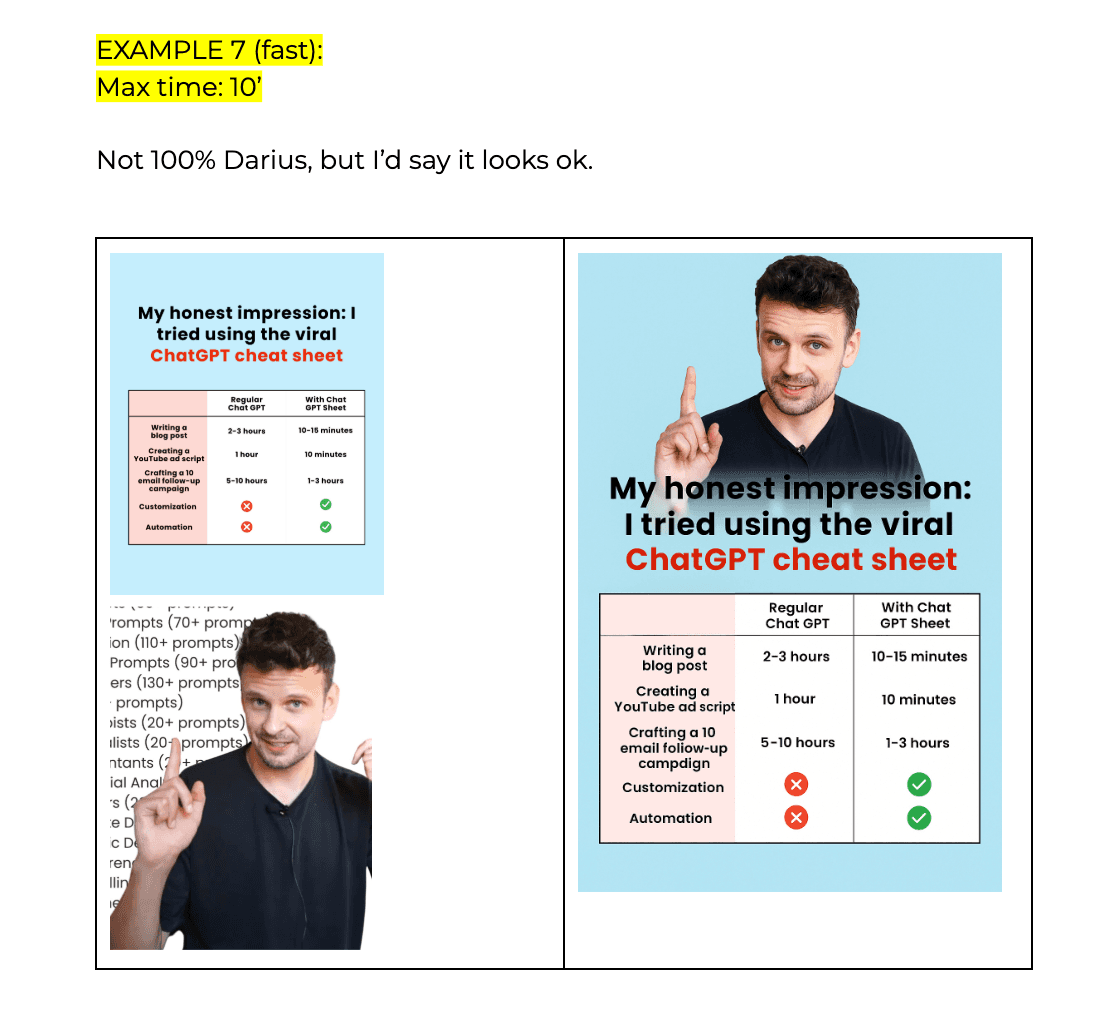
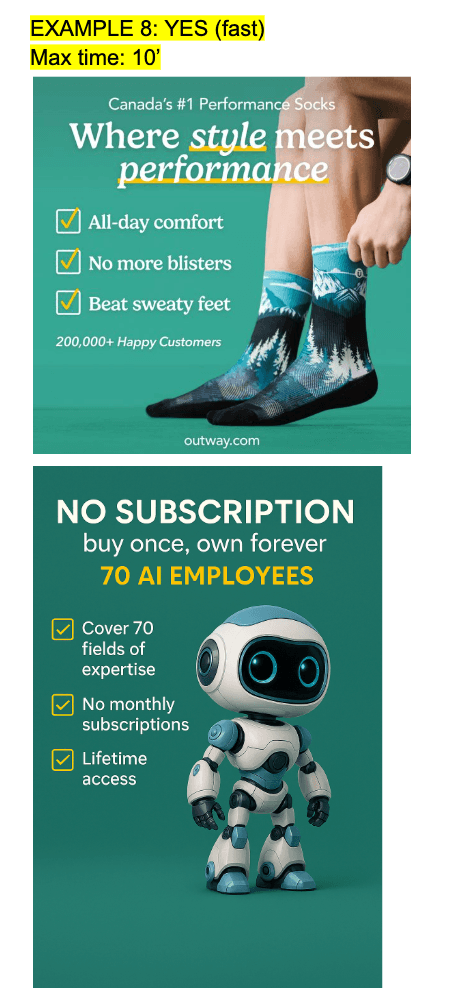
The 20 page PDF looked like this:
Step 5: Address the Unspoken Fear: No One’s Getting Fired
The moment you bring AI into any creative process, a silent question emerges: Am I being replaced?
It’s rarely said out loud, but it’s always felt. And if you don’t address it head-on, it will sit like static in your team.
So we did. I made it clear that no one was losing their job. This wasn’t about replacement. It was about scale and freeing up time for better output and more creativity.
We added a new target (doubling ad output) and tied a bonus to AI usage. One week later, the results were in:
Targets hit.
Team morale intact.
And no new hires needed.
This Saved Me at Least $3K a Month (or $36K a Year) - It’s Your Turn Now
I didn’t add new tools. I didn’t hire anyone. I just paused long enough to rethink the way the work was getting done. I stopped trying to solve problems with more hands and started solving them with better structure.
That’s what it means to think in an AI-first way.
And it works whether you’re leading a team or doing everything yourself.
We teach this mindset inside, practical strategies and tools across multiple programmes and tools. But even if you’re flying solo, you can start now.
Look at one part of your workflow: identify the one thing that’s eating your time, your focus, or your energy.
Ask yourself: Is this truly high-value work, or just something AI could be doing better, faster, or earlier in the process?
That’s your starting point.
Shift one thing.
See what changes.