Hyper Entrepreneur Dispatch
how to become irreplaceable in the age of AI
June 2, 2025
We used to find jobs and build teams around skills.
You’d hire a copywriter for words, a designer for visuals, an accountant for numbers, a marketer to push campaigns forward.
Each person brought depth in one domain, and that was enough.
But AI doesn’t respect skills in the way we once did.
It doesn’t care how long you’ve studied, how many clients you’ve served, or how polished your portfolio is.
If the work can be templated, replicated, or averaged out—AI will do it faster.
It’s getting dramatic:
Demand for freelance writing jobs has dropped by 30% since ChatGPT entered the scene, according to Imperial College London.
30% of companies replaced human workers with AI in 2024, with more planning to follow.
The question is no longer, “Who’s the best at this skill?”
It’s: Who knows how to turn tools into outcomes?
And that’s where orchestration enters.
From Technician to AI Orchestrator
We’re living through a quiet collapse of the single-skill professional.
Not because their value disappeared, but because the value shifted: upward, outward, and across domains.
An orchestrator doesn’t focus on execution alone.
They see the whole system. They think in workflows, not tasks. They understand where AI can accelerate outcomes, and where human judgment still matters.
An AI Orchestrator is someone who builds systems that do the heavy lifting, using the right AI tools to generate, test, and refine ideas at speed. They design workflows that run without hand-holding, improve over time, and create room for deeper, more strategic work. It’s not AI automation for efficiency’s sake—it’s orchestration for scale, consistency, and meaningful output.
If the tools are the orchestra, they are the conductor—bringing harmony, direction, and intent.
Think of a copywriter who used to spend a full day writing a landing page. Now, they prompt three first drafts in fifteen minutes, curate the best ideas, refine the message, and test variations—without ever opening a blank doc. They’re not writing less. They’re orchestrating more.
This isn’t a title. It’s a mindset shift.
And it’s the difference between being replaceable and being indispensable.
There’s a quiet grief in letting go of what you used to be good at. But there’s also a quiet power in learning how to build something better
Start Vibing Now: Vibe Coding & Vibe Marketing
Andrej Karpathy, former Tesla AI lead and co-founder of OpenAI, coined the term vibe coding to describe a different way of building. In his words, it’s about “fully giving in to the vibes, embracing exponentials, and forgetting that the code even exists.”
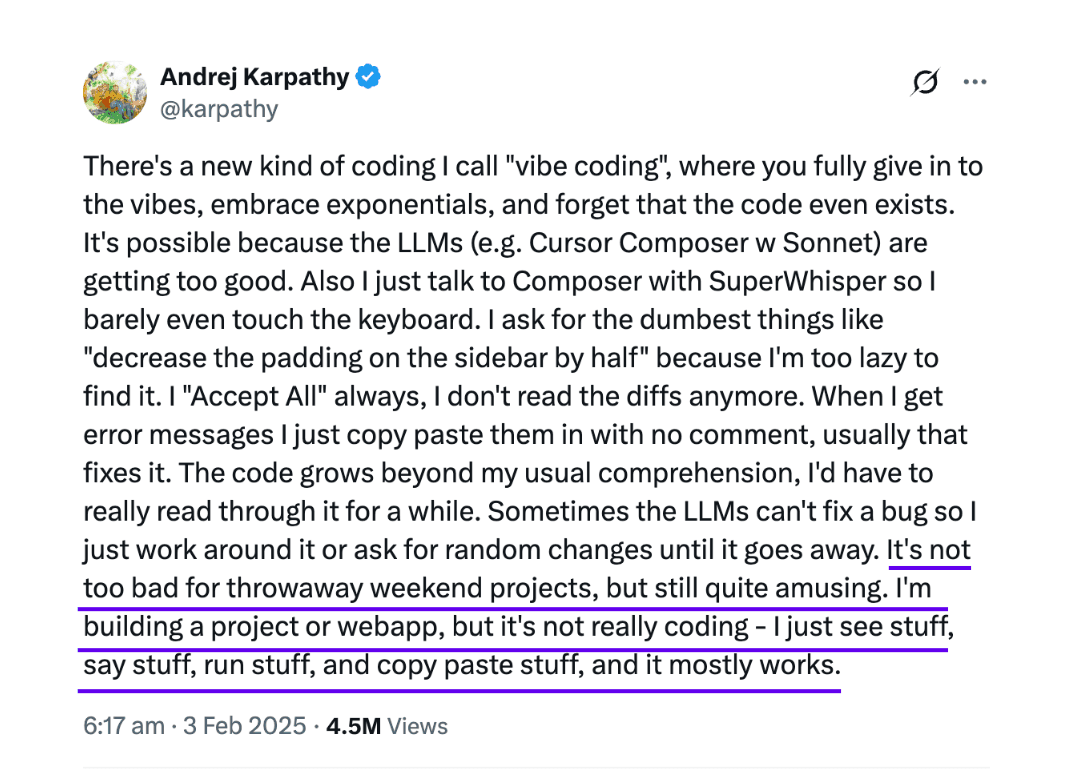
In practice, he uses tools like Cursor, an AI-native code editor, and SuperWhisper, a voice interface, to work with models like GPT-4 or Claude. He describes a workflow where he speaks what he wants, reviews the AI’s suggestions, and iterates by pointing out what’s broken—often without writing a single line of code.
If you want to try it yourself, tools like Lovable make it possible to go from plain text to a working app—just by describing what you need.
The work is still getting done. But the developer’s role has changed.
It’s no longer about typing. It’s about shaping.
Not about syntax, but direction.
Less craftsmanship—more orchestration.
The same shift is unfolding in marketing.
In vibe marketing, the strategist doesn’t start with a blank doc or design file. They prompt the campaign copy in ChatGPT, build angles with Jasper, test variations in AdCreative.ai, and run visuals through Canva or Runway.
Zapier or Make handles the distribution.
The value isn’t in touching every word or every image—it’s in knowing what good looks like, and guiding the system to deliver it.
They’re not doing less.
They’re just not doing it the old way.
This is what orchestration looks like in practice: less control over every detail, more influence over the outcome.
What AI Orchestration Actually Looks Like
Three real-world paths. Choose the one that’s closest to you:
1. If You’re in a Job: Build the Flow, Not Just the Content
You’re a content manager at a media company. Every week, you need to deliver articles, newsletters, and SEO assets, on repeat.
But instead of grinding through each task, you’ve built a flow. You use Perplexity to surface ideas, ChatGPT for first drafts, Claude to adjust tone, and SurferSEO to optimise. Grammarly handles polish.
Your real job isn’t writing—it’s overseeing a system that writes. You review, refine, and reallocate your time toward higher-leverage moves. While others stay busy, you stay strategic. Things move when you’re involved. That’s why you’re trusted.
2. If You’re Leading a Team: Design Systems, Not Tasks
You’ve got five people across marketing, ops, and support. But you don’t delegate tasks—you build flows.
Marketing owns the prompt libraries.
Ops runs automations through Make.
Support is handled by a bot-first inbox that only escalates what matters.
Every week, you sit down and ask: what’s still manual? What’s breaking? What’s duplicating effort?
Your job isn’t to be everywhere. It’s to see everything. And to keep the whole system flowing—without burning people out.
3. If You’re Solo: Scale Without Growing
You’re running a one-person business—but it doesn’t feel like it.
You’ve mapped your week into zones: marketing, delivery, admin. And each one runs on its own AI flow.
ChatGPT drafts your emails. Claude sharpens your client proposals. Canva builds your assets. Zapier ties it all together.
You’re not reacting anymore—you’re conducting. You open your dashboard, move through the day, and ship what matters.
The difference isn’t in how much you do. It’s in how little of it you do manually.
How Do You Become an AI Orchestrator?
In our AI Consultant Certification, I call this the Skill Bridge method.
You don’t start by learning everything about AI. You don’t need to become an engineer or chase every model update.
You start with what you already know.
Let’s say you’re a recruiter, and you can see the writing on the wall. AI is already automating outreach, screening, even interviews.
But instead of panicking or doom-scrolling LinkedIn for trends, you go narrow.
You focus on one question: how can AI make recruitment better?
You test tools like ChatGPT to write personalised job ads. You build prompt stacks and automations that scan CVs for client-specific criteria. You run interviews through Whisper, then generate instant scorecards with GPT-4. You even set up a Notion dashboard that auto-updates candidate status using Zapier.
Within 90 days, you’ve built a system. You’re no longer just filling roles—you’re showing clients a faster, smarter way to hire.
You outpace traditional recruiters. Or, if you prefer, you start consulting for agencies who need your help catching up.
You haven’t just protected your role—you’ve made yourself nearly-impossible to replace.
You’ve crossed the bridge.
And in doing so, you’ve become an AI orchestrator: someone who knows how to take a domain, layer in intelligence, and build something better.