Hyper AI Picks
what counts as a “photo” now
August 22, 2025
🔍 AI Idea of the Week
What counts as a “real” photo anymore?
Sam Altman recently sparked a heated debate about what we even mean by "real" when it comes to images.
You’ve probably seen that viral AI video of bunnies bouncing on a trampoline. Cute, convincing… and completely synthetic.
For a moment, plenty of people thought it was real…
Sam Altman used it as an example to raise a bigger question: What even counts as a “photo” anymore?
An iPhone snaps multiple frames at once and merges them. A Pixel can erase strangers in the background. And Google Photos will now let you describe an edit: “make the sky sunset orange”, and it just happens.
Here’s what’s changing right now:
1. Google Photos goes AI-first
A new Create tab lets you generate GIFs, 3D effects, highlight reels, and more - directly from your photo library. You can even describe edits (“remove the cars in the background”) and watch them happen instantly.
2. Watermarks and credentials
AI-edited images on Google devices now come with content credentials showing what’s been changed. Regulators, like the EU, are also pushing for AI watermarking standards to be adopted everywhere.
3. Instagram tests AI avatars
Instagram is experimenting with AI-generated profile images and avatars, hinting at a future where parts of your social presence are created, not captured.
Photos are no longer just a record of what happened: they’re becoming a mix of capture, enhancement, and generation. Platforms are starting to signal those differences with tags and watermarks, but the definition of a “photo” is clearly expanding.
For founders and creators, the opportunity is to use that expansion, not fight it.
You don’t need a film crew or design agency anymore. With tools like Midjourney or Runway, you can generate campaign images in minutes.
That means you can test 20 different ad creatives before lunch, or spin up a brand identity for a new idea over the weekend.
What used to take weeks of planning, shooting, and editing is now at your fingertips.
⚡ AI Signals
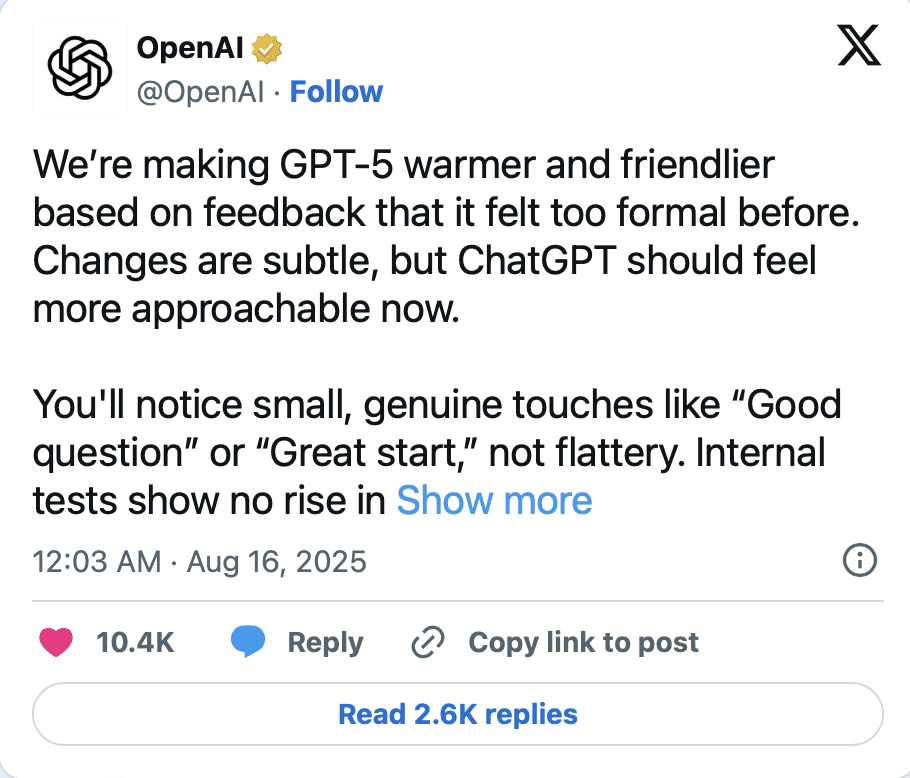
GPT-5 just got friendlier
OpenAI updated GPT-5’s tone after feedback that it felt too stiff. Now it adds natural touches like “Good question” or “Great start.”
Why it matters: The fact that users pushed for GPT-4o’s return shows how much we value AI that feels human, not just one that performs well. GPT-5’s update shows that people prefer a voice that feels familiar, empathetic, and… friendlier.
Google Search’s AI Mode goes global… and books restaurants
Google’s AI Mode is rolling out to 180 more countries. In the US, Ultra subscribers can now ask it to handle restaurant bookings via OpenTable and Resy.
Why it matters: Search is shifting from links to actions: you’ll spend less time browsing, more time delegating.
Meta adds AI dubbing to Reels
Instagram and Facebook can now dub videos into other languages, starting with English ↔ Spanish, while mimicking your own voice and expressions.
Why it matters: Creators can instantly reach new global audiences without reshooting or voice-over work.
Google Docs will read your writing aloud
Docs now has an audio mode powered by Gemini that can narrate your text, with adjustable speed and voice style.
Why it matters: This makes documents more accessible, and helps writers hear how their words flow.
Grammarly launches AI agents for education
New agents inside Grammarly can grade drafts, suggest sources, and help teachers detect AI-written work.
Why it matters: It positions Grammarly as more than a grammar checker, now it’s a tutoring and teaching tool.
🛠 AI Tool We’re Testing: Clay
For founders, creators, and anyone building a network, the hardest part isn’t meeting people… it’s staying connected.
One AI tool describes itself as a “home for your relationships.” 😄
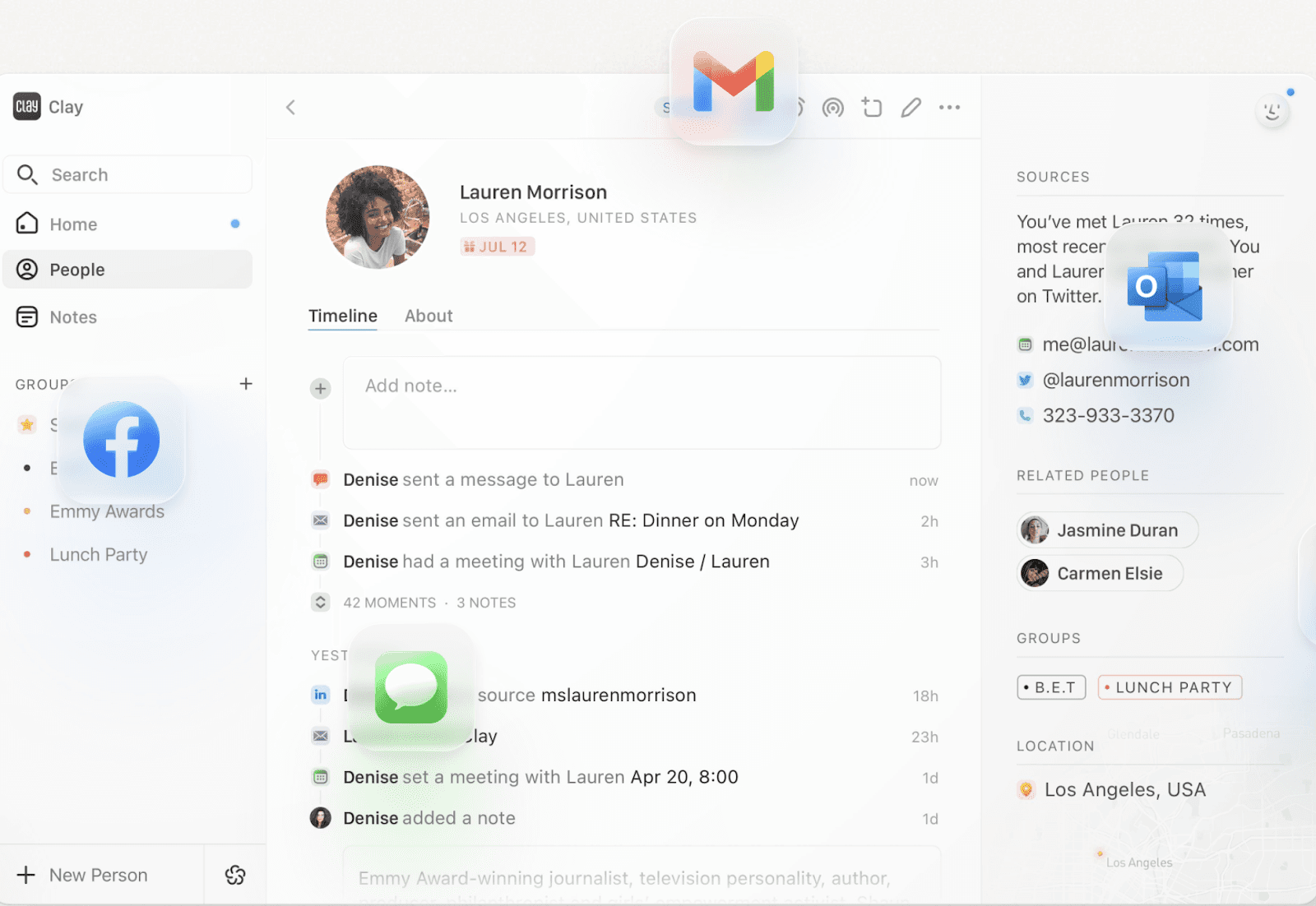
Clay connects to your email, calendar, LinkedIn, and notes, and quietly builds a living map of the people in your world.
Then you can just ask: Who did I meet at that conference last year? or Who in my network knows someone at Stripe?
Clay will pull it up instantly, with the context you’d normally spend hours digging for.
And it goes further too: drafting thoughtful follow-ups, surfacing birthdays, even helping you remember the little details that make reconnecting easier.
Have you tried it yet? You can start free at clay.earth.
🌟 Prompt of the Week: Selling your ebooks as a solopreneur
Somebody asked me recently: “I’ve been writing ebooks on my own… how do I actually sell them?”
It’s a great question, because creating is only half the battle. The other half is packaging, positioning, and finding readers who will actually buy.
Here’s a prompt you can drop into ChatGPT to get a clear plan:
# ROLE
You are a growth strategist who specializes in helping solopreneurs turn digital products into profitable businesses.
# TASK
Help me design a plan to sell my ebook by:
Identifying the 3 most effective sales channels for my audienceSuggesting realistic pricing strategies (including upsells or bundles)Outlining a simple funnel: how to attract attention, capture emails, and convert readers into buyersRecommending quick, low-cost marketing experiments I can run this weekGiving me examples of creators who have successfully done this
# CONTEXT
[Describe your ebook’s topic, target reader, and your current audience size/platforms]
# CONSTRAINTS
Keep the advice practical, budget-friendly, and focused on actions I can start immediately as a one-person business.